
Imagine you’re in a tube where everything is... the edges are an inch away from you... I don’t want to be in there.
Exploring the vocal cords... the individual... and society.

Last week I guided my wife on an imaginative exploration of the throat and she precisely mapped what happens when the vocal cords are in distress—without even realizing it. She thought she was imagining herself in the throat, and she perfectly detailed an interaction in the body she could feel but never quite understood.
Which was, in her own words:
“It feels like my throat is literally closing, chest getting tight, feeling like I want to run.”
There was no indication that she was remotely thinking about the vocal cords. And through play or the imagination, we arrived at a valid map of the larynx.
But here’s the thing. As special as my wife is to me, she’s no different than everyone else I’ve talked to over the course of the last year—people who I’ve engaged on a variety of topics, from the country to what they sense and feel in the body. All unexpectedly leaving me with a map of dysfunction in the human body and the world.
What follows is a transcript of the very casual conversation I had with my wife Anna. One where the vocal cords—they’re really vocal folds because they’re not quite cords—are stuck in the middle of the larynx (voice box), in what’s understood as a “closed” position.
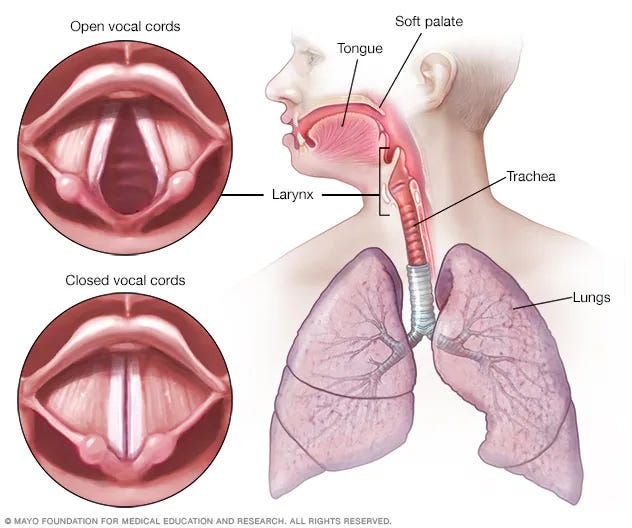
(The vocal folds are the two vertical bars that look like lips in the diagram above)
Adam: Imagine shrinking and showing up in the throat. What do you see?
Anna: It’s red. And dark. But, you know, shadowy. It’s not like pitch black dark.There’s a little bit of light so it’s shadowy. And it’s got like, you can see the walls of the throat. They’ve got a throat-like texture. Bumpy’s the wrong word, but you know it’s uh… corrugated, a corrugated texture.
Adam: So what does corrugated mean?
Anna: There’s folds. And then it’s slimy. It’s got a little bit of like mucus and like wetness. It’s moving. It’s sort of like pulsing.
Adam: What’s it pulsing with?
Anna: Blood flow… Swallowing… breathing… everything sort of just like moves as the things move around it.
Adam: And do you feel like it’s like a cozy environment to be in?
Anna: No, it’s gross. It’s slimy and dark and wet. And warm.
Adam: If you were to yell… would there be… what would be the—
Anna: It’d be echoey.
Adam: Do you feel at home in the throat?
Anna: No, it’s uncomfortable… It’s small. It’s like a tube, so I feel like I have to like stay in the middle so I don’t touch the walls that are slimy.
Adam: And so what would make—what would make you feel more comfortable in there?
Anna: If it was bigger. If I had more space. If it was like less slimy.
Adam: And what could you do to make it more comfortable there?
Anna: Nothing. There’s no space. I need more space. It physically is not enough space.
Adam: Well, how could you create more space?
Anna: I would have to shrink.
Adam: Let’s say there’s a way for you to create more space.
Anna: I would move the walls… I would have to push them to make the big—everything wider… I’d make it wider, make it a big—bigger space.
Adam: So you want to make the walls wider so that you have more space because previously you were in the middle of them and you felt like you didn’t—you couldn’t move?
Anna: Yeah, it wasn’t enough space. I was too close to the walls.
Adam: And what happens when you create more space?
Anna: I can move around. But right now I can’t really move around.
Adam: Where do you want to move around?
Anna: I mean, I don’t. I don’t want to be in there. But like in general if I could like I could walk around or like sit down or something… Right now I can’t move.
Adam: Why would you want to walk around—walk around or sit down?
Anna: Because I’m just standing in the middle, not able to move… Imagine you’re in a tube where like everything is… the edges are an inch away from you… That’s uncomfortable. It’s claustrophobic.
Adam: Imagine that you could redesign the throat. What would it look like?
Anna: It would be more spacious and open.
Adam: And with more spacious, is there an echo?
Anna: Yeah, there’d still be an echo. I mean more space usually creates more of an echo.
Adam: So then the difference would be what?
Anna: I wouldn’t touch the walls… I could move around.
Anna used the word folds to describe the walls of the throat, which from the perspective of the vocal folds are the walls.
If you look closely at the diagram below, there’s a mass on each side of the vocal folds called the ventricular or vestibular folds, more commonly referred to as the “false folds.”
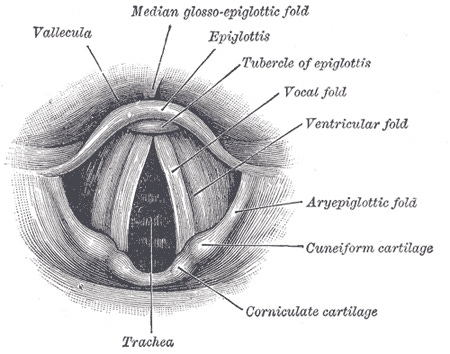

These walls—the false folds—are mucous membranes surrounding the vocal folds, capable of making distinct guttural or throaty sounds, but primarily serve in a support role. They do things like provide lubrication to the vocal folds, which don’t create their own lubricant:
It’s got a little bit of like mucus and like wetness.
They also support the body in other ways, like opening and closing to protect the lungs when we eat and drink. In fact, the entire voice box moves as one to facilitate these functions, as described by Anna:
Swallowing… breathing… everything sort of just like moves as the things move around it.
But this is where we begin to see the dysfunction in the body. Because the vocal folds see everything moving around them. But they don’t see themselves moving with their surroundings. They’re separate, moving away:
It’s uncomfortable… I feel like I have to like stay in the middle so I don’t touch the walls that are slimy.
They don’t even want to be lubricated by the part of the voice box responsible for lubricating them. So they’re removing themselves from their surroundings. And then claiming to have no space:
There’s no space. I need more space. It physically is not enough space.
… all when they have surrendered their own space…
So when the vocal folds are rejecting the false folds they’re actually rejecting themselves, the body. Because now they no longer have what they need to function. There is no lubrication. And there is no space.
So when Anna says:
“It feels like my throat is literally closing, chest getting tight, feeling like I want to run.”
We now know the parts of the larynx—from the vocal folds staying in a closed position to the false folds pressing into them to the epiglottis (which is the flap above)—are all working together to restrict airflow to the lungs.
But we have yet to address the echo, which to me is the most remarkable part of the relationship between the vocal folds and the false folds.
If the vocal folds were to push back against the false folds that made them feel claustrophobic… If Anna were to push back against whatever in her life was giving her that claustrophobic feeling in her throat… there’s not only more space but also more of an echo:
Anna: I mean more space usually creates more of an echo.
Adam: So then the difference would be what?
Anna: I wouldn’t touch the walls… I could move around.
And with more space, the vocal folds… Anna… can now move around and vibrate. Anna… the vocal folds… can now vibrate to create an echo in the space. But by moving closer to the false folds, they’ve already reorganized the space, moving the false folds into a position that allows them to be a functional part of the body.
Whereas previously, all the movement of the voice box was moving around the vocal folds—where the vocal folds were staying in their locked or closed position—now the vocal folds create or are the movement in the voice box. Pushing back against the false folds reconnects the vocal folds to the voice box and larger body.
In our everyday lives, we disconnect from the vocal folds (really the body) when we decide to please others (our parents, society, the world) at the expense of ourselves or what we feel and sense in the body. We ignore or reject our feelings just to fit in. But when we do that, we’ve forgotten that the body needs every single one of its individual parts to function, and that we are the body itself.
We all cut ourselves off as the vocal folds have from the body. Become something separate from the world—something that needs to shrink and please the world. And how claustrophobic that is.
From there we look around and feel like the country or world is encroaching on our space, taking away our freedom. And it is, but because we’ve failed to participate all along—moving away from the country as the vocal folds were moving away from the false folds. Thinking we could get away, when really we’re doing the exact opposite—giving the country space to take up more and more of what was once our space, shrinking ourselves every step of the way. And then seeing the false fold as the problem standing in our own way. Failing to look in the mirror.
But here’s the thing. Honoring the authority of the body over the social contract is the only way the whole—the world—advances. Because without the vocal fold, where would be the communication for the body? And without the false fold, where would be the lubrication for that communication? Or the pressure build up to create sound? The body gets nowhere without each and every unique individual part allowing the body to work through it.
And it is the same with the world. Without Anna standing up for herself, the world is missing a vocal cord. It sounds so selfish to reject others for ourselves or what we feel in the body, but following the authority of the body is the least selfish thing any of us could do. Because what we feel and sense is the world working through us. The body working through us. They are the same movement. But we don’t see that. We’re the isolated vocal cords that fail to see that we’ve created a world that rejects us.
This disconnection is a core tenet of modern society. It becomes our default in early childhood. And I was not at all surprised to learn that after showing Anna the dysfunction of the vocal cords, she suddenly remembered that she had been diagnosed with a vocal cord dysfunction in childhood. One that exactly matched how she had just described feeling in the throat, “…like my throat is literally closing, chest getting tight.”
But make no mistake. She may have had a vocal cord “dysfunction,” but it is a dysfunction of a disconnected world showing up in the body. The body of children. And how sick it makes us all.
And now in our country we feel like we can’t breathe, like we’ve given away our power and the false folds of the world have filled our space. When will we wake up and realize that we created the echo chamber?